GATE108 Events
An exclusive community ran high-end events on Excel, inboxes and manual invoices. I replaced all of it with one platform — from curated checkout to Swiss QR-bill invoicing — in two months.
 Next.js 16
 SupabaseStripeResend
 TypeScript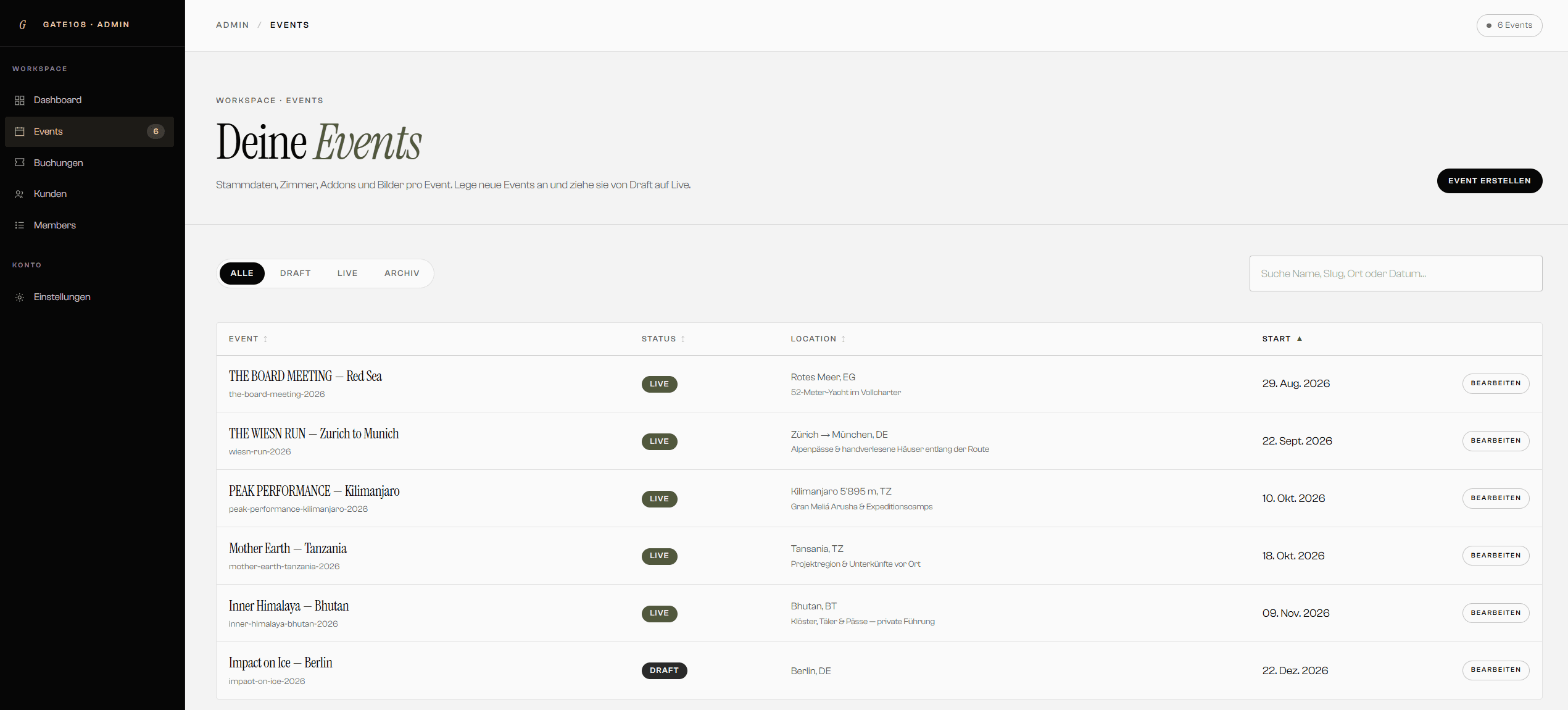
A million-euro event series, held together by spreadsheets.
GATE108 is a private members community running exclusive events in the Alps and on the coast. Behind the scenes, everything lived in scattered tools: bookings and cancellations in Excel, guest communication in inboxes, invoices written by hand, suite assignments tracked manually.
In this segment, the software has to match the brand — fast, polished, frictionless. And there was no off-the-shelf product for this process: curated guest lists, suite allocation, addons and perks, two payment cultures. It had to be custom.
Everything the back office touches, in one tool.
The team now runs the entire event lifecycle in one admin platform — it handles the community's full booking and payment volume.
- Multi-event management with suites, capacity and a drag-and-drop occupancy plan for assigning guests to rooms.
- Checkout pages are built inside the tool — descriptions, perks, addons and discounts configured per event, gated by access codes.
- Two payment rails: Stripe checkout, plus a full Swiss invoicing engine — QR-bill, VAT codes, gap-free document numbering, credit notes and automated dunning.
- All guest communication runs through templated emails with delivery tracking — confirmations, invoices, reminders, sold-out notices.
- The groundwork for an AI agent that takes over routine back-office operations is already laid.
Boring reliability, deliberately engineered.
Payments and legally relevant documents don't forgive race conditions — most of the engineering effort went into making failure modes impossible rather than unlikely.
- Row-level security first: every table is policy-protected before any query ships.
- Race-safe by design: suite reassignment and booking status changes only happen through locked database procedures — the UI can't corrupt state.
- Stripe webhooks are idempotent and replay out-of-order events instead of dropping them.
- Emails go through an outbox with delivery states (queued, sent, delivered, bounced) — nothing is fired and forgotten.
- Every stage ended with a smoke run against the real environment — Stripe test mode, real mail sandbox, real database.
Stay in mockups longer.
My biggest takeaway: clients don't care about the tech — they care how it looks and feels, and that only becomes real at the end. I wrote production code too early and paid for every UI iteration twice. Next time, the look gets locked in mockups before the first migration runs.
“Unit tests green is not the same as production ready — every stage ends with a smoke run against the real environment.”
Planning something similar?
I design and ship AI agent systems, data platforms and full-stack products — from first idea to production.
Get in touch